
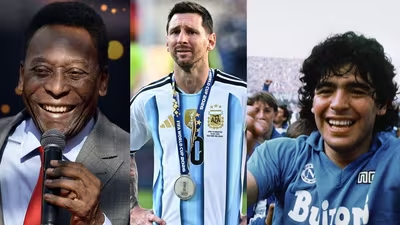
Lionel Messi’s final image from the 2026 World Cup was not another coronation. It was the sight of him in tears, a silver medal around his neck, after Spain defeated Argentina 1–0 in extra time. At 39, he had returned four years after the triumph in Qatar, scored eight goals, created four more and carried the defending champions to one last final. Yet football denied him the ending that seemed written for him.
Event Context
Maradona would have bristled. Beckenbauer would have remained unmoved. Pele would have allowed the argument to burn before returning it to the man beneath them – the defeated captain who could no longer contain his grief.
Also Read: Did the World Cup 2026 final bring together two best teams of the tournament? Numbers tell a very different story
He returned after losing finals, after public rejection, after briefly walking away from international football. He kept accepting a burden that had become cruelly personal. Eventually, he transformed Argentina not by imitating Maradona’s fire, but by giving a younger generation something steadier around which to gather. His authority developed gradually, until the quiet captain became the emotional centre of the national team in his own way.
“I thought leadership had to be heard,” Maradona might have confessed. “He showed that sometimes it is the refusal to leave.”
Pele would have enjoyed the admission, perhaps a little too visibly. That was where their old rivalry would have returned. For decades, football’s debate over ultimate greatness had been framed around them: Pele, the radiant king whose three World Cups made him the game’s universal symbol; Maradona, the rebellious genius who carried Argentina through 1986 as though talent could become an act of national liberation.
Messi had left the World Cup in tears, denied his second crown and the farewell that millions had imagined for him. He had also left with nothing more to prove.
The argument would continue, as football’s greatest arguments always do. But the highest table would no longer be set for two.
Player Focus
Somewhere in the heavens, Diego Maradona would have hated it. He would have felt the defeat before analysing it, because Maradona never possessed the distance required to treat Argentina as merely a football team. For him, the shirt was identity, rebellion and wounded national pride stitched together. Messi’s tears would have reached him immediately.
Pele, seated nearby, would have responded differently. He would have reminded Diego that football owes even its greatest players no perfect farewell. His voice would have been calm, his manner statesmanlike, but the serenity would not have concealed his pride. Pele spent a lifetime representing football to the world; he also remained fiercely conscious of his own throne.
“Do not confuse the ending with the legacy,” he might have told Maradona.
Those tears would have forced Maradona towards a more difficult admission. For much of Messi’s international career, Argentina had not merely asked him to win. It had asked him to become Diego.
He inherited Maradona’s shirt, his expectations and the impossible idea that Argentine leadership had to be theatrical. Maradona commanded through emotional force. He occupied every room, confronted every enemy and made his teammates feel that an entire nation had entered the match with them. Messi was quieter and more inward. For years, that difference was mistaken for absence.
Maradona himself once questioned whether Messi possessed the personality to lead Argentina. Looking down after the 2026 final, however, he might finally have recognised that Messi’s leadership had never been inferior. It had simply spoken another language.
Messi led the return.
Messi did not settle that argument. He made it inadequate.
Beckenbauer would have admired the architecture of his career: the young phenomenon who destroyed defences with acceleration, then the older master who controlled them with intelligence. Gerd Muller would have brought everything back to the extraordinary weight of goals. Garrincha, mischievous and instinctive, would have cared less about numbers than the pleasure of watching defenders know where Messi intended to go and still find themselves abandoned in his wake.
Bobby Charlton would perhaps have said the least. He understood dignity too well to turn another man’s tears into weakness. He would have recognised that Messi was not crying because his legacy had been broken. He was crying because, after winning everything, losing still mattered.
Pele would have seen the joy at the foundation of it all. Before the records, trophies and comparisons, there was the intimate relationship between Messi and the ball. Children did not need statistics to understand him. They saw a small figure passing through larger bodies, treating crowded spaces as private corridors and making the most scrutinised sport on earth resemble play.
Maradona would have seen something more personal: a man who had survived being presented as his reincarnation. Argentina spent years measuring Messi against a ghost. Yet Messi neither became Maradona nor escaped his shadow by rejecting it. He built another kind of Argentine greatness – less volcanic, more sustained; less rebellious in appearance, but no less resilient.
Pele would still have refused to place Messi above him. Maradona would hardly have surrendered his own claim either. But neither could honestly place Messi below them.
As the stadium emptied and Messi disappeared into the tunnel, the old table would have fallen silent. For generations, Pele and Maradona had been seated so closely together that football appeared to have room for only one supreme name.
Then Pele would have moved his chair slightly to the left. Maradona, understanding the gesture, would have shifted his to the right.
Team Analysis
Diego would not have accepted that easily. He would have paced, cursed Spain’s control of the match and insisted that Messi deserved better. Franz Beckenbauer, elegant and analytical even in eternity, would have quietly corrected him: Spain had been the superior team. They had denied Messi space, separated him from Argentina’s runners and reduced a side accustomed to his late interventions to almost nothing in attack.
