
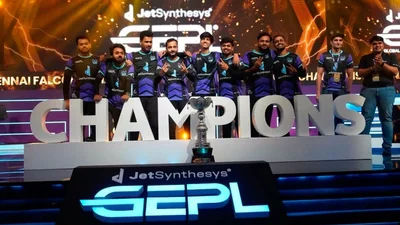
Season 3 of the Global e-Cricket Premier League wrapped up in Pune on Sunday, August 9, with eight franchises, up from six last year; a record ₹ 3.1 crore prize pool; and a broadcast deal that took the tournament to American and Canadian television for the first time. Two seasons ago, GEPL was played in front of a single stadium’s worth of fans. Now, it has exploded beyond the subcontinent, and I spent the weekend at the Jairaj Sports and Convention Centre in Pune talking to the people behind that virality — franchise owners, players, and the board of JetSynthesys, the entertainment and tech company that built the league around the mobile title Real Cricket.
When drawn further, he revealed, “We want to go national, so it’s a big plan that’s being made now. Real Cricket matches in the GEPL are not T20 or even T10 ties; they consist of five-over innings with five wickets per side. It’s short, it’s exciting, and there’s a real jeopardy attached to every four, six, and dismissal. Importantly, the entire contest is wrapped up in under half an hour, and that timeframe is likely one of the major factors behind the boom in the viewership numbers. Traditional cricket asks for a massive time commitment. A single T20 innings takes nearly two hours, while Test matches span five full days, creating a natural barrier for casual viewers. GEPL has shifted the broadcast equation entirely. Instead of competing with marathon sports coverage, it occupies a category closer to a sitcom episode — a viewer can watch a full match during a study break or lunch hour, enjoying a complete sporting narrative without derailing their daily routine. Jogesh Lulla, the company’s senior vice president for sports, described the plan as a Ranji Trophy for e-cricket — smaller, localised inter-college tournaments that funnel talent up into the professional league, the way domestic first-class cricket feeds the Indian team. It’s all in the works. It’s not about one or two colleges here. We want this to be an entire all-India league. So we’ll decide how we start, but that’s the goal. A sport can survive and thrive only once its talent pool is wide enough that no single publisher or city carries it alone. “If you have only a handful of players, you know it’s not going to survive. What’s he going to do? JetSynthesys is proud of the open, anyone-can-qualify pipeline of the GEPL, but that system can only be truly fair if women are actually entering the funnel in meaningful numbers and qualifying for the main auction on merit. Right now, they’re not, but Lulla flagged a game-development complication specific to the format of the e-sport — specifically, the modelling and rendering of the in-game player avatars.
What’s more interesting is how JetSynthesys wants to build between now and Season 4. I asked him at the press conference whether that expansion was something planned as a build-up to Season 4, or something round the year, and his reaction was coy: “You’ll see, it’s coming soon. Also Read – HT at Esports World Cup 2026: Doors open for cricket, but ‘easy gold medal’ for India not enough incentive Girish Menon, JetSynthesys’ chief strategy officer, framed it as a solution to a problem of depth. The auction that filled those 64 slots was the most competitive the league has run. Teams spent ₹ 62.75 lakh of a combined ₹ 64 lakh purse, a 98% utilisation rate, and four of the five most expensive players switched franchises rather than being retained. All-rounder Jetha Ram went to the Sara Tendulkar-owned Mumbai Grizzlies for ₹ 3.5 lakh, the highest fee in GEPL’s three seasons. The size of that price tag was not lost on him — “Everyone was saying that we had taken this player for 3.5 lakh rupees. He can’t do much on his own,” he tells me — but he justified it in some style, finishing the tournament as leading run-scorer with 488 runs and winning the MVP award despite losing in the final. That opportunity is yet to bridge the gender gap, with no female player making it to the final 64 roster across the past three seasons.
But if you’ve got the whole country playing it, that’s when the game becomes long-term and sustainable,” he said.
