
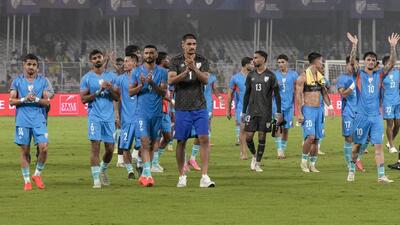
The announcement that the Indian football team would not compete in the FIFA Asean Cup — for which they were on special invite — “due to our commitment with the Brazilian football federation” was one of those moments made either for head-shaking or an explosion of memes.
This was just an addition to the list of the surreal Indian football moments that have recently come upon us: the kind that not even someone under the influence of all manner of psychotropic substances could have thought up. But more important than all that we know, however, is the AIFF’s proposal to change its name to the Football Federation of Bharat (FFB). Like Bollywood actors who change the spelling of their names in the hope of changing their fortunes. “I think it’s a problem of culture. India does not have a culture of football, but they are good in other sports. Someone should forward to Senor Ancelotti a copy of the most forward-thinking and incisive audit done of Indian football recently. Not by anyone currently occupying high office at the AIFF/FFB, but by a long time footsoldier of the Indian game.
Now, following a draw with Panama in Bangalore last week and the 0-4 defeat against Brazil, the match against Uruguay is upon us. We have only just been given the schedule for the upcoming Indian Super League for men on September 29. About the Indian Women’s League, there is currently only a broad range of dates starting October 16 but no schedule. The announcement of the India v Brazil friendly on October 3 in Kolkata is a classic bread and circus combo for which the ASEAN Cup is being given a pass.
You have to work on this to build a new generation of players,” he said.
That we have 35-odd districts out of a total of 800 plus which the Talent Cluster report says, “command 80 percent of India’s professional minutes. Studying data from the last 11 seasons of Indian pro football until 2024-2025, the Talent Cluster says footballers from those 35 districts across mostly seven states – making up 7.4% of India’s total population – have featured in more than 80 percent of game time in all of India’s professional matches (I League, ISL).
“Our Talent Clusters – Indian football hotbeds and how to develop them” uses data to reinforce what has already been known in India: that the focus around player development and grassroots needs to be a part of the sport’s core.
