
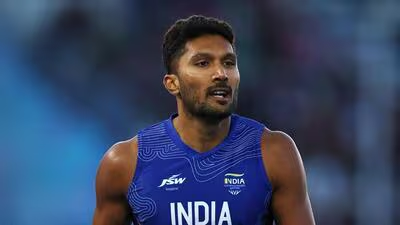
New Delhi: In the fall of 2017, when Tejaswin Shankar arrived at the Kansas State University in the US as a freshman, his 19-year-old body weighed 78kgs with a fat percentage of around eight percent. At 6’4,” his frame was lean with relatively little upper-body muscle mass and he checked most of the anthropometric characteristics associated with elite high jumpers.
There has been a significant mental shift too, as is the tactical understanding of managing ten events through two unforgiving days, but nothing beats what meets the eye. “Cliff believed I should try different events. He was curious to explore commonalities among various events and use them to better my high jump.
That said, the only Indian to break the 8000-point barrier in decathlon has pushed his body to its limits to become a force in his chosen discipline. Because in India we don’t really think that way,” Tejaswin said, that was a big shift.
“Each gramme of the 12kgs that I have gained in these 8-9 years is pure muscle,” he told HT.
After competing in a college-level pentathlon and a short-track heptathlon, Tejaswin turned out for his first decathlon in 2022 and amassed 7592 points. It was 66 points shy of the then national record, held by Bharatinder Singh. 60-odd points can be covered if you plan well,” he said. His best bench presses would be 60-65kgs.That has now gone up to 110kgs. Based on a number of testing metrics, we can say that his upper body strength has increased by about 28% over the last couple of years and his muscle mass has gone up by 15-20%,” Lombard said.
The journey began soon after with a fortuitous spot in the college 4X400m relay team when one of the runners was unavailable. A brutal mix of power and endurance, 400m is among the most testing track events considering the metabolic acidosis that kicks in in the second half. “That’s when I thought that I can do this. His in-season training involves at least three gym sessions a week divided into upper body, lower body and stretching and mobility exercises. “The idea is to move really heavy weight in shortest span of time. It’s a significant departure from his early years when he hated hitting the gym. “He’s more of an outdoors guy, and during his pure high jump days, he’d rarely do upper body work.
“As a pure high jumper, there was no need for me to work my scapula or my pectoralis, and it took me some time to understand the physiology and body mechanics needed for different events,” Tejaswin said. That builds power,” Tejaswin said.
