
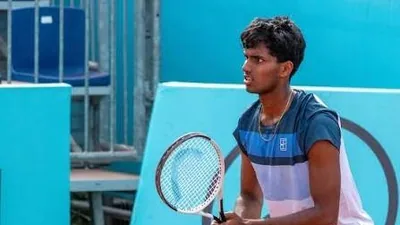
The All India Tennis Association ( AITA ) had originally proposed a 12-member squad, including six women, for the Aichi-Nagoya Games. In a shocking move, the government has pruned India’s tennis squad for the upcoming Asian Games , leaving the contingent without its leading singles contenders. But that list was slashed to just seven players.
However, AITA’s request to include all the players it had selected for tennis has not been accepted. The final list for the tennis included just seven players, with only Ankita Raina and Rutuja Bhosale among the women retained. The development came about after the Sports Ministry released the final sanction order, issued on August 22, which cleared 492 athletes for the Asian Games, across 35 disciplines.
Why did the government cut the squad?
The framework allows the ministry to reject names recommended by national sports federations if they believe the entries do not meet the performance benchmarks. For individual events, the framework uses recent performances and rankings as benchmarks, while team events and doubles are judged separately. The policy also contains a relaxation clause under which the ministry can approve athletes or teams that fall short of the prescribed benchmark if there are justifiable sport-specific reasons.
According to theSports Ministry’s press statement ‘Selection Criteria for participation of Individuals and teams in Asian Games 2026 and other multi-sports events’, released a year back, the government has a defined selection framework for multi-sport events, which ensures that athletes with a realistic medal chance are selected rather than sending players merely for participation. AITA interim Secretary General Sunder Iyer told PTI that while the association tried its best to convince the government to approve the 12-member squad, the ministry cited its medal-potential criteria. “We tried our best to convince the authorities to send all the selected players, but they are citing the criteria of sending only the top-8 players in Asia.
It’s disappointing but the criteria is the same for all sports, what to do,” Iyer said.
With limited time left before the Games kick-off, it is unlikely that his disagreement will be solved, but it does expose the larger question on who should have the final say when a national federation believes it has identified its best medal prospects, but the government decides that some of them do not meet its own benchmark?
