
The men’s team has won the trophy just once, the women’s side has never gone past a quarterfinal, yet both sides have produced moments that shaped the sport back home. India’s hockey World Cup history is a mix of one shining triumph and decades of near-misses that still matter. Here are six of them.
At the 1986 World Cup at London’s Willesden Sports Centre, India finished last among the participating teams — 12th place, their worst-ever World Cup showing. Sometimes individual brilliance survives a team’s collapse. And yet Mohammad Shahid, India’s captain and one of the finest dribblers the game has seen, was named Player of the Tournament. Shahid wove past defenders with a control that made the ball look glued to his stick, and even as India’s results fell apart around him, his form never did. His individual campaign is widely remembered as one of Indian hockey’s most bittersweet World Cup stories.
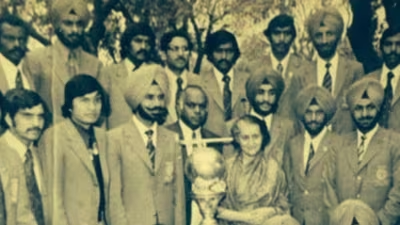
India’s women returned to the World Cup in 2018 after an eight-year gap and marked it with a statement. In their opening match, against hosts and Olympic champions England in London, Neha Goyal put India ahead in the 25th minute, and even though England equalised late through Lily Owsley, the 1-1 draw was a result nobody expected. India then beat Italy 3-0 in a playoff to reach the quarterfinals — their first appearance in the World Cup knockout stage since that debut edition in 1974. Rani Rampal was just 15, the youngest player in the Indian squad, when she walked into the 2010 World Cup in Rosario, Argentina. Her performances helped India climb to ninth in the world rankings, their best standing since 1978. India’s overall campaign at the 2010 home World Cup was underwhelming, but one afternoon at the Major Dhyan Chand National Stadium was instantly memorable. In a pool-stage match watched by a packed home crowd, India routed arch-rivals Pakistan 4-1. India and Pakistan have met five times at the World Cup, and India have the better record, with the 2010 result remaining the most emphatic of those wins. At Mandelieu, France, in 1974, an Indian side led by Ajinder Kaur opened with a loss to Belgium, then won three straight games, including a 1-0 upset of eventual champions the Netherlands. They then lost 0-1 to Argentina in the semifinal and 0-2 to West Germany in the bronze medal match, finishing fourth. In the final against Pakistan on 15 March 1975, Pakistan took the lead in the 17th minute, and India looked rattled. Surjit Singh pulled the score level in the 44th minute, and then, in the 51st, Ashok Kumar — son of the legendary Dhyan Chand — found the goal that won India the World Cup 2-1. It capped a tough campaign in which India had already survived a 3-2 extra-time semifinal against hosts Malaysia.
A teenager from a cart-puller’s family in Haryana had announced herself on hockey’s biggest stage. They were eventually eliminated by Ireland on a penalty shootout after a goalless quarterfinal, but the run marked a genuine revival for Indian women’s hockey on the world stage. She left as its breakout star. Across six matches, Rani scored seven goals — the second-highest tally in the tournament — and was named Young Player of the Tournament. It was the start of a career that would go on to define Indian women’s hockey for the next decade, but this tournament was where the world first noticed her. India’s women didn’t just show up at their first World Cup — they nearly gatecrashed the podium. That result carried India to the top of their pool. That heartbreak remains India’s best-ever finish at a Women’s World Cup, and more than fifty years later, no Indian women’s team has come close. India’s only World Cup title came down to a single strike. Ashok had walked into the tournament as a fringe player, added to the squad only as the 16th man. He ended up delivering the biggest moment in Indian hockey’s history, and fifty years on, it remains the country’s lone World Cup crown.
It remains the joint-heaviest margin in a fixture historically defined by tight, tense contests, and for a team that would go on to miss the semifinals, it was the single result fans still talk about from that tournament.
