
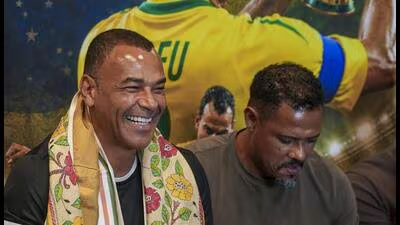
Kolkata’s Brazil connect is often reduced to a quadrennial cliché: yellow-and-green flags strung across narrow lanes, children in Brazil shirts and neighbourhood walls transformed by life-size murals of Ronaldo, Ronaldinho, Cafu and Bebeto. It’s all true, but also wildly incomplete. Brazil are not a team Kolkata suddenly decided to support. The relationship grew over decades, through World Cups, television sets and stadium visits, through players who arrived to make a living and somehow became a local.
This was an opportunity to see in the flesh the man who had won three World Cups and was nearing the end of his career. The story begins, naturally enough, with Pele. It was an exhibition match, and the Cosmos were an American club. But for Kolkata, none of that mattered. For a country in which Brazil had largely existed as a name in newspapers, radio reports and the occasional grainy film reel, Pele gave the country a face. This love affair coincided with the time another Brazilian football institution arrived. And then, almost quietly, the Brazilians started staying. He was the club’s first Brazilian recruit. But he could play. He didn’t merely succeed, Barreto became a local. In an interview with the BBC, he offered perhaps the simplest explanation for why the relationship with Kolkata worked: “They loved me and I loved them. It was an exchange.”
On September 24, 1977, Edson Arantes do Nascimento arrived at Eden Gardens with the New York Cosmos to play Mohun Bagan. A reported 80,000 people poured into Eden Gardens for the game which ended 2-2. In February 1984, Sao Paulo’s under-20 side came to India for the Tata Steel-organised Super Soccer series. They played a Bengal XI at Salt Lake and won 1-0. In 1986, East Bengal signed Manilton Santos, a Brazilian midfielder who had previously played for Vitória and Botafogo. But it was Jose Ramírez Barreto, arriving without fanfare at Mohun Bagan in 1999, who turned the connection into something more intimate. Barreto was 23, knew little about India and didn’t speak the language.
Sao Paulo’s own archive recalls a crowd estimated at more than 100,000 and the promotional nickname given to the visitors: “The Superboys of Brazil”.
Barreto eventually scored more than 200 goals for Mohun Bagan over 11 years, making him one of the most successful foreign footballers in Indian football of all time. Over 30,000 fetched up in May 2012 to see him play his final match for Mohun Bagan at Salt Lake stadium; Barreto obliged them by scoring past an outstretched Subrata Paul now the national team director. Douglas, a former Santos player, arrived in 2002. In three years with East Bengal, he helped them win 11 trophies, including consecutive National Football League titles and the 2003 ASEAN Club Championship where the red-and-gold brigade beat then Asian Champions League finalists BEC Tero Sasana. Brazilian physio Djair Miranda Garcia arrived in 2008 at the relatively low-key United SC before working with Kolkata’s major clubs and later moving to Gokulam Kerala. Carlos Roberto Pereira took charge of East Bengal in 2006 before moving to Mohun Bagan a year later. Marcos Falopa was appointed by East Bengal in 2013, when the club reached the AFC Cup semi-finals. Now with Mohun Bagan, Miguel Figueira came into Indian football through Bangladesh before becoming East Bengal’s ISL Golden Ball winner in 2025-26. The ISL’s Brazilian connection, meanwhile, had begun with Elano, the former Brazil international who played 50 times for his country and was named player of the tournament in 2015 and continued through Rafael Crivellaro, Cleiton Silva, Marcelinho and Roberto Carlos who was player-manager for Delhi Dynamos in 2015.
He later played for Mohun Bagan and Mohammedan Sporting and, like several Brazilians before and after him, stayed in Kolkata long after his playing days were over. The exchange was not restricted to players. Brazilian coaches followed the same route. By then, Brazil’s relationship with Kolkata football had become almost informal in its regularity. The latest generation makes the point neatly.
