
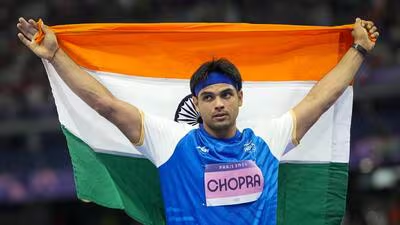
New Delhi: It started with the great Milkha Singh. After independence, India didn’t compete in the 1950 Games and the 1954 edition saw them return empty-handed.
Event Context
The Commonwealth Games have been a stepping stone for Indian athletes to test themselves before the grind of tougher multi-sport showpiece events like the Asian Games and the Olympics.
In some disciplines, such as athletics, swimming and cycling, the field has been world-class, making podium finishes tougher for Indian athletes. In others, like boxing, shooting and weightlifting, India enters prepared for a bigger haul.
Chopra won the gold medal at the 2018 CWG in Gold Coast, and in a way it was his first major triumph on the international stage that set him on the path to phenomenal success at the highest level of the sport. He missed the 2022 CWG due to an injury but is back for Glasgow—this time navigating a difficult phase of his career at 28. He missed a medal at the 2025 World Championships and has struggled with back and hamstring injuries.
It is not only Chopra who will be searching for redemption in Glasgow; there will be Murali Sreeshankar as well. The long jumper has made an impressive comeback after surgery following the knee injury that derailed his Paris Olympics campaign. Since his comeback, he has consistently cleared the 8m mark. The silver medallist from the last edition is among the medal contenders with a jump of 8.38m this season. In the high jump, Sarvesh Anil Kushare has been steadily raising the bar, whether by qualifying for the 2025 World Championships final or breaking the national record (2.31m) this season. The Paris Olympian is fourth on the world list this season. England’s Kimani Jack has also cleared 2.31m. The biggest attraction, however, will be Olympic and world champion Hamish Kerr.
Tejaswin Shankar
Tejaswin Shankar, the bronze medallist in the high jump at the last edition, will compete in the decathlon, the gruelling event in which the Asian Games silver medallist has been setting new benchmarks. Hopes will also be high for steeplechaser Parul Chaudhary and long-distance runner Gulveer Singh, while the spotlight will also be on 19-year-old high jump sensation Pooja, already an Asian Championships gold medallist and national record holder (1.93m), and Gurindervir Singh, who set the national 100m record of 10.09 seconds at the Federation Cup.
Boxing
Player Focus
However, India’s performance at this edition cannot be judged only by its position in the overall medal tally because of the curtailed sports programme. Several disciplines like wrestling, badminton and table tennis, which traditionally provided India with the bulk of its medals, were removed from the roster.
Therefore, the results will need to be viewed as performances in individual disciplines and from the perspective of India’s preparation for the Asian Games, which are barely two months away.
After a nine-month injury lay-off, he returned to action at the Doha Diamond League with a throw of 85.67m. Though he finished fourth, the performance has renewed his hunger and fire to deliver at the world level.
Team Analysis
But by the time the 1958 Games in Cardiff rolled around, Milkha Singh was ready to make his mark. He won gold in the 440 yards sprint with a timing of 46.6s, this was also India’s first gold medal at the Commonwealth level. It announced his and India’s arrival on the world stage.
Match Outlook
India has a contingent of 124 athletes, including 27 para athletes, who will compete in 13 disciplines. Among them, boxing and weightlifting should fetch the India maximum dividends. Track and field has always been a tough proposition at the CWG with the presence of England, Australia, Canada and the African nations. But India did well to secure eight medals (1-4-3) in the previous edition in Birmingham, and, going by the way national records have tumbled this season, the performances of the country’s track and field athletes will be interesting to watch.
Neeraj Chopra
The biggest star leading India’s campaign will be two-time Olympic and worlds medallist Neeraj Chopra.
The javelin field, though, is one of the toughest, and the competition will be no less intense than the Olympics. From reigning Olympic champion Arshad Nadeem—a burly thrower capable of monstrous 90m-plus throws—to multiple world medallist and 2024 Olympic medallist Anderson Peters of Grenada, world leader this season Rumesh Tharanga Pathirage of Sri Lanka, who threw 92.62m at the Rome Diamond League, and current world champion Keshorn Walcott of Trinidad and Tobago. It will be the most anticipated event. Not to forget Rohit Yadav, who threw 87.05m to become the second-best thrower this season.
Murali Sreeshankar
Boxing fetched India seven medals at the Birmingham CWG, and with a full-strength squad of 14 boxers in Glasgow, India should be looking for an improved haul this time. Spearheaded by Tokyo Olympics bronze medallist Lovlina Borgohain (75kg), it will also provide a good platform for some of the new faces, such as Jadumani Singh (55kg) and Aditya Pratap (65kg), to compete fearlessly. For the experienced Sakshi Chaudhary, a two-time world youth champion who beat Nikhat Zareen in the selection trials, it will be a big opportunity to cement her place in the team. The team will also look to Paris Olympians Preeti Saipawar (54kg) and Jaismine Lamboria (57kg) to return with gold medals.
Weightlifting
Leading the charge will be none other than Tokyo Olympics silver medallist Mirabai Chanu, who remains a force to reckon with when it comes to high-stakes global competition. The weightlifting squad was hit by doping cases, leading to the original 16-member squad being reduced to 12.
Judo
The 14-member judo team is also expected to improve upon its performance of three medals from the last edition. Birmingham silver medallist Tulika Maan and Inunganbi Takhellambam, who ended India’s 13-year wait for an Asian Championships medal in April, will be the judokas to watch out for. India also won a gold and a silver medal in lawn bowls at the last edition, and the team will be looking to repeat that performance. A strong showing at the CWG will provide Indian athletes an ideal launchpad for the Asian Games and the LA Olympics qualifiers.
source
That a CWG is being held this time is itself an achievement for organisers Commonwealth Sport. At one point, it looked as though the multi-sport event would fall apart after Victoria, Australia, withdrew as host due to escalating costs. Glasgow saved the 2026 Commonwealth Games by stepping in as host at the last minute and agreeing to organise a truncated Games with fewer sports, resources and venues.
India will further boost the Games by organising a full programme in Ahmedabad in 2030.
Glasgow 2026 will therefore feature only 10 sports and six para sports, hosted across four venues within a concentrated eight-mile corridor. Four of Glasgow’s iconic venues—Scotstoun Stadium, the Scottish Event Campus (SEC), the Glasgow International Arena and Tollcross International Swimming Centre—will host the Games. The organisers are promoting the 11-day event as a celebration that combines “world-class sport with a future-focused vision, built and delivered by the vibrant spirit of Glasgow.”
