
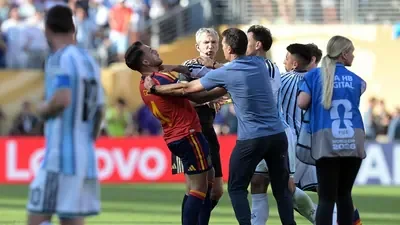
Argentina ended the 2026 FIFA World Cup final without the trophy, without a shot on target and with FIFA investigating their players’ involvement in an ugly post-match brawl. Back home, however, the dominant reaction was not criticism but absolution.
Event Context
The description stood in glaring contrast to events at the New York-New Jersey Stadium. Leandro Paredes confronted several Spanish players, including Eric Garcia and Gavi, after the final whistle, triggering a wider altercation between the two squads. Players exchanged shoves and had to be physically separated as Scaloni attempted to calm the confrontation. FIFA subsequently appointed a disciplinary and ethics prosecutor to investigate the brawl.
The incident did little to disturb the protective wall erected around the team by much of Argentina’s press.
It was an extraordinary collective suspension of scrutiny after a final in which Argentina were not merely defeated but comprehensively controlled.
The 1-0 scoreline concealed the scale of Spain’s superiority. Luis de la Fuente’s side outshot Argentina 20-2, placed 12 efforts on target and produced every one of the final’s first 20 attempts. Argentina became the first team to complete the regulation 90 minutes of a World Cup final without registering a single shot.
Neither of their two generously recorded attempts in extra time tested Unai Simón. Emiliano Martinez’s World Cup final-record 12 saves were the only reason Argentina remained level until the 106th minute.
Former Argentina international Marcelo Gallardo offered a possible explanation rather than criticism, describing the semi-final victory over England as an “emotional drain”. “Argentina hadn’t faced a team like Spain before – a team that steals the ball from you, and you can’t get it back,” Gallardo said. “They didn’t let us recover or play.”
The tactical verdict was correct. Spain denied Argentina possession, territory and meaningful attacking opportunities. The attempt to place that failure within the emotional aftermath of the England semi-final, however, could not disguise how completely Scaloni’s team were outplayed.
Also Read: FIFA World Cup 2026 Team of the Tournament: Messi, Mbappe and Rodri lead a Spain-dominated ultimate XI
Argentina’s president, Javier Milei, also joined the chorus, pointing to the team reaching three finals across four World Cups and winning the 2022 edition.
“No one can hold anything against them because they gave their all,” Milei said.
Argentina were entitled to take pride in reaching another World Cup final. That achievement, however, did not make the final performance beyond criticism, nor did it turn the confrontation after the whistle into an insignificant footnote.
Player Focus
Clarin carried a photograph of a crying Lionel Messi beneath the front-page message: “They gave it their all: there is nothing to blame them for.” Its editorial argued that, beyond the result and football itself, there had never previously been such a special bond between the Argentine public and its national team.
La Nacion followed with: “Argentina gave their all, and they are the pride of the nation.” Pagina|12 used “From here to eternity”, while sports newspaper Olé reached for a line from the national anthem with “May they be eternal”.
Yet even that brutally accurate assessment concluded that Argentina’s overall campaign had been “beyond reproach”, citing the players’ tears and their acknowledgement of the supporters after the match.
Effort became the blanket defence. Tears became evidence of virtue. The team’s previous achievements were used to shield its players from an honest examination of both their performance and their conduct.
Spain’s domination reduced Argentina to spectators
One Argentine newspaper even described Lionel Scaloni’s side as “well-mannered and respectful”, dismissing the disorder after their 1-0 extra-time defeat to Spain as a handful of “regrettable isolated incidents”.
Argentina’s discipline had already unravelled before the match ended. Enzo Fernández was dismissed after receiving a second yellow card for a reckless challenge on Pau Cubarsi, leaving his team with 10 men before Ferran Torres struck Spain’s winning goal in the 106th minute.
Alejandro Wall acknowledged the gulf in a Tiempo Argentino column, describing Spain as “a whirlwind of football and determination that dominated Argentina at will”.
“They had possession, the chances, the tempo of the match; they were in complete control,” Wall wrote. He said Argentina simply attempted to survive and appeared, from the statistics, to be “an inert body”.
Spain controlled the ball, controlled the match and ultimately controlled their emotions well enough to lift the trophy. Argentina lost all three.
source
Scaloni continued the same theme during an emotional press conference in which he cast doubt over his future. “If they give everything the way they did today, it sets a great example for the people and for our country,” he said. “When you leave everything like that, it’s very hard to find fault with anything.”
