
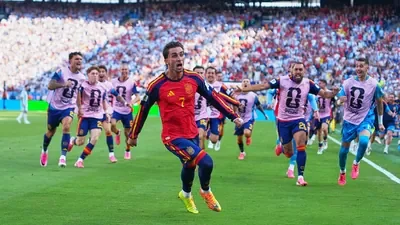
Spain ended a 16-year wait to reclaim football’s biggest prize, defeating defending champions Argentina 1-0 after extra time in a gripping FIFA World Cup 2026 final at MetLife Stadium in New York on Sunday. Substitute Ferran Torres emerged as the unlikely hero for Spain, scoring the decisive goal in the 106th minute to crown Spain world champions for only the second time in history, adding the World Cup title to the European Championship they won two years ago.
Event Context
It was Torres’ first and only goal at this year’s World Cup, coming from his 14th attempt of the tournament. But it was a goal Spain will remember for a long time. The strike restored Spain to the summit of world football and denied Lionel Messi a second consecutive World Cup title in what he has indicated will be the final World Cup match of his career.
The triumph gives Spain their second World Cup crown, their first since South Africa 2010. Fittingly, just like 16 years ago, they arrived at the tournament as reigning European champions and completed a historic double by conquering the world once again. Spain also hold the Women’s World Cup title, won in 2023, making them the only European nation in history to hold both crowns simultaneously.
Spain vs Argentina LIVE Score, FIFA World Cup Final: As it happened…
The stalemate after 90 minutes marked only the fourth World Cup final to remain goalless at the end of regulation, joining the 1994 Brazil-Italy, 2010 Spain-Netherlands and 2014 Germany-Argentina finals. Only the 1994 decider stayed scoreless through extra time before Brazil prevailed on penalties.
Spain thought they had finally found the breakthrough early in extra time when Nico Williams bundled the ball into the net, only for the celebrations to be cut short after the referee ruled Mikel Merino had fouled Nicolas Otamendi in the build-up.
The goal was scrappy rather than spectacular. Porro’s cross lacked quality, forcing Williams into an awkward header rather than a goal attempt. Martinez’s decision to rush off his line only compounded Argentina’s problems, allowing Torres to finally find the net after an otherwise frustrating tournament in front of goal.
Player Focus
Lionel Scaloni’s men had built their run to the final on resilience. They had repeatedly recovered from difficult situations throughout the knockout rounds, with 10 of their 19 tournament goals coming after the 80th minute. But against Spain, La Albiceleste never resembled the side that had marched through the tournament. They failed to register a single shot on target or create any meaningful attacking threat throughout regulation time.
Their task became even harder when Enzo Fernandez was sent off after receiving a second yellow card late in regulation time, capping a desperately disappointing evening for Argentina’s midfield.
La Roja’s relentless pressure eventually paid off in the second half of the extra time. Lamine Yamal proved to be the catalyst as he drew the defenders towards him before shifting the play wide. Pedro Porro’s looping delivery found Nico Williams at the byline, and the winger did brilliantly to nod the ball back into the danger area. Ferran Torres reacted quickest, arriving unmarked to smash a fierce finish high past Emiliano Martinez in the 106th minute.
Torres believed he had sealed the result seven minutes later when Yamal threaded a superb through ball behind Argentina’s defence, but the assistant referee immediately raised the offside flag to deny the forward a second goal.
How Spain dominated Argentina
Spain ended this tournament having conceded just one goal in eight matches, which came in the quarterfinals against Belgium, setting a World Cup record for fewest goals allowed by a champion. The win also stretched their unbeaten record of 38 matches, which comprises 29 wins, nine draws, and is now the outright holder of the longest such streak by any European team ever. Italy went 37 matches (28 wins, nine draws) from October 2018 through September 2021, before Spain ended that streak.
For long stretches, it looked as though Spain would once again be left wondering how they had failed to break Argentina’s resistance. Luis de la Fuente’s side controlled possession, dominated territory and dictated the rhythm of the contest, but found themselves frustrated by an Argentina team that, despite offering virtually nothing in attack, refused to yield.
Argentina threw everything forward in the closing minutes. Messi finally came to life, and despite being down to 10 men, the South American side threatened to drag the final to penalties. But the two chances they carved out never troubled Spain, with neither forcing a shot on target.
